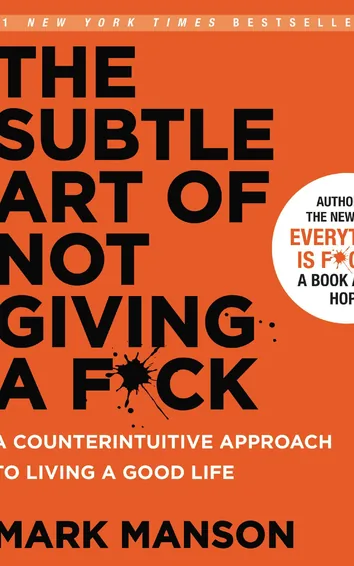

The Subtle Art of Not Giving a F*ck — A Counterintuitive Approach to Living a Good Life book cover by Mark Manson
Amazon customers: 4.5 out of 5 · 161,176 ratings

The Subtle Art of Not Giving a F*ck

Adult • Self-Help • Personal Development • Motivational • Relationships, Parenting & Personal Development
A Counterintuitive Approach to Living a Good Life
Mark Manson Collection • Book 1 of 2
Challenges relentless positivity Focus on human limitations Encourages responsibility for values Uses humor and personal anecdotes Reframes wealth as meaningful experiences

In The Subtle Art of Not Giving a F*ck (2018), Mark Manson, a popular blogger, challenges the modern insistence on relentless positivity. He contends that improving our lives depends less on forcing constant optimism and more on recognizing human limitations, confronting fears and faults, and accepting responsibility for the values we choose. Manson emphasizes that not every concern deserves our attention and that discerning which struggles matter is central to personal growth.

Blending academic research with blunt, profane humor and candid personal anecdotes, Manson encourages readers to stop avoiding painful truths and to cultivate courage, perseverance, honesty, curiosity, and forgiveness. He reframes true wealth as meaningful experience over superficial measures and offers irreverent, practical guidance for prioritizing what to care about in a life of limits and uncertainty.

Choose a book format
Paperback prices by retailer

Pick a format, then compare retailer prices. The main button points to the preferred option for the selected format.

Edition information

Book details

Series
Mark Manson Collection Book 1 of 2
Publisher
Harper
Publication date
2018
Language
English
ISBN
0062899147

Self-Help + Personal Development + Motivational

Reader guide

What to Know Before Reading The Subtle Art of Not Giving a F*ck

Mark Manson argues that constant positivity is neither realistic nor desirable; instead, he advocates accepting limitations, confronting painful truths, and choosing a limited set of values worth caring about. Using research, personal stories, and blunt humor, he focuses on responsibility, resilience, and honest self-assessment as the tools for a more grounded, contented life, and reframes success as prioritizing meaningful experience over superficial rewards.

Join the Reader List

Join bks.social’s reader list for book recommendations, reader updates, featured titles, and occasional community news. No noise. Just the important things.

G-NRIS™ story intelligence

Why readers connect with The Subtle Art of Not Giving a F*ck

A concise view of the book’s strongest literary signals and the reading interests shared by people connected to it on bks.social.

Story profile

G-NRIS™ identifies The Subtle Art of Not Giving a F*ck primarily as Self-Help, Nonfiction, and Personal Development. Its strongest themes include Acceptance of Limitations, Personal Responsibility, Resilience and Perseverance, Honesty and Self-Assessment, and Prioritization of Values. Prominent narrative patterns include Blunt Humor, Candid Personal Anecdotes, and Challenging Conventional Wisdom.

Reader connection

Readers connected to this book most often reflect Psychological Moral Explorer reader archetypes. Their strongest shared genre interests include Thriller, Literary Fiction, Historical Fiction, and Science Fiction. They are commonly drawn to themes such as Survival, Understanding Human Nature, Exploring The Fractured Self, and technology.

About the author

Mark Manson

Mark Manson

Mark Manson (born March 9, 1984) is an American self-help author and blogger. As of 2026, he has authored or co-authored four books, three of which, The Subtle Art of Not Giving a F*ck, Everything Is F*cked: A Book About Hope, and Will, were New York Times bestsellers.
Author information: Wikipedia

Join the book lovers community

Continue the conversation in the Book Hub for The Subtle Art of Not Giving a F*ck

Visit bks.social’s Book Hub for reader discussions, reviews, posts, quotes, questions, reading activity, related books, and G-NRIS story intelligence.